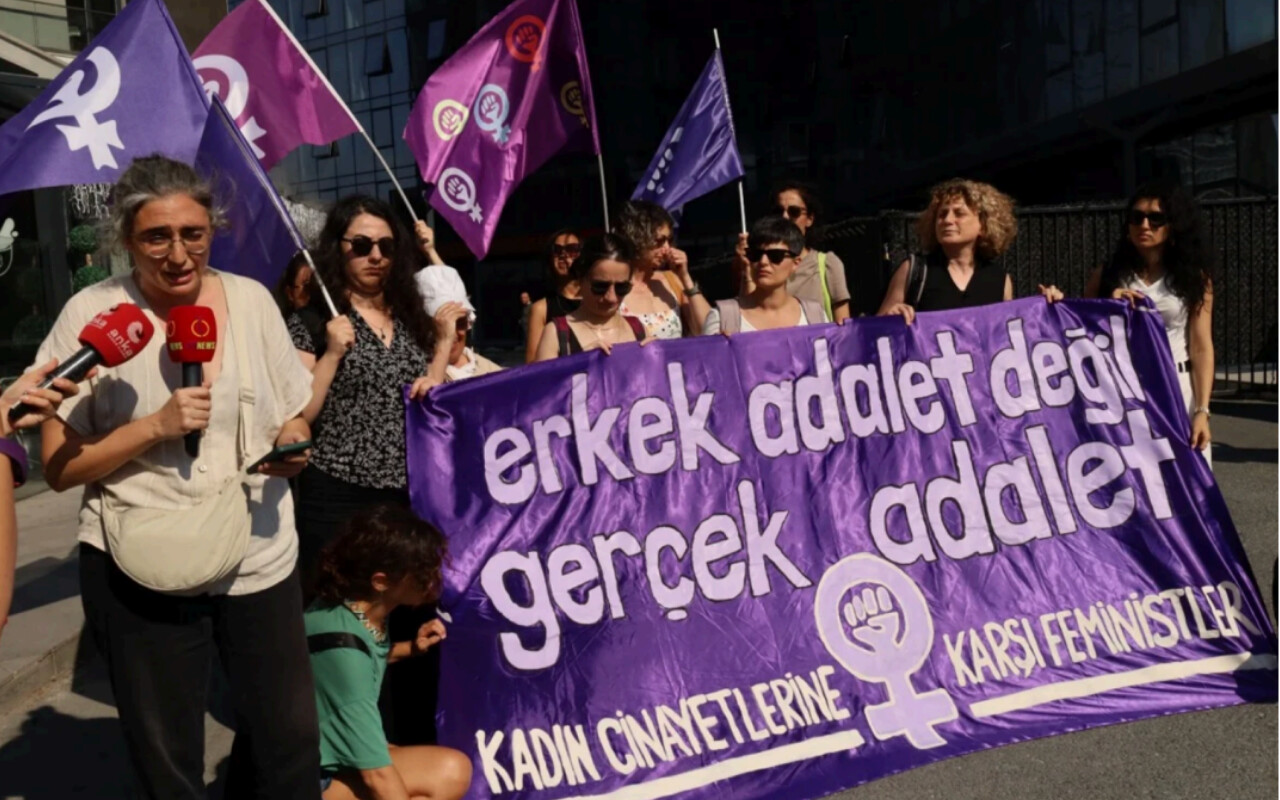
Invisible Perpetrator, Visible Violence


In Turkey, cases of male violence against women are often widely reported, yet responsibility is not always clearly named. The first headlines appear quickly. The courtroom process that follows: hearings, postponements, verdicts, and sentence reductions – often receives far less sustained attention.
That gap matters because news coverage does more than report what happened. It also shapes how the public understands violence, justice, and accountability. Cases are often framed as shocking individual incidents, while the broader structure of male violence and the legal logic surrounding it receive far less attention.
When the Perpetrator Disappears
One of the clearest problems, according to journalist and bianet editor Evrim Kepenek, who has long covered gender, rights, and male violence in Turkey, is the way mainstream reporting hides the perpetrator. In her written responses, she argues that sensational language and emotional framing push responsibility into the background and turn the perpetrator into what she calls a “hidden subject.”
“We see that the perpetrator is being concealed in the media, almost transformed into a hidden subject,” Kepenek said. In her view, one of the clearest problems in mainstream reporting is that the violence remains visible while the perpetrator fades into the background.
That language does more than blur responsibility. Kepenek says mainstream media often relies on sensational and emotional framing, emphasizing dramatic details or reactions instead of clearly naming the crime and the perpetrator. As a result, cases are often presented as individual tragedies rather than as part of the broader structural reality of male violence.
Data compiled from bianet’s Male Violence Monitoring Reports shows the scale and continuity of the issue. In the first five months of 2026 alone, men killed at least 112 women. In the previous three years, bianet recorded at least 299 women killed in 2025, 378 in 2024, and 333 in 2023. These figures make clear that male violence is not a series of isolated incidents, but a persistent and measurable pattern. To allow 2026 to be included in a fair comparison, the graph below shows the number of women killed in the first five months of each year between 2022 and 2026.

Figure 2.: bianet Male Violence Monitoring Report data for the first five months of 2022–2026. Source: bianet, “Male Violence Monitoring Reports”
Lawyers Su Ökdemir and Esin Yeşilırmak, both of whom work on male violence cases, point to similar problems from the legal side. Ökdemir says mainstream outlets still often rely on incomplete or misleading legal information and sexist reporting practices, even when some journalists try to approach these files from a feminist perspective.
She cites phrases such as “love murder” and “jealousy murder” as examples of language that frames these crimes as emotional exceptions rather than as part of a wider structural problem. She also highlights a gendered double standard: women’s faces and private lives are often exposed, while perpetrators’ images remain hidden.
Yeşilırmak says the same distortion appears in the legal framing of news itself. She argues that media coverage often relies on sensational angles instead of accurate legal explanation.
She notes that preliminary forensic findings are often treated as conclusive evidence, prosecutors’ requests are sometimes reported as final rulings, and terms like “released” are used even when a trial continues without detention. That language, she says, can deepen the public’s sense of impunity.
After the First Headline
The problem continues after the first headline. Kepenek says some cases are closely followed, but often only when they attract strong public attention or gain visibility on social media.
Once a case moves into the slower stages of the legal process, hearings, postponements, appeals, and rulings often receive far less attention. She says both the speed of the news cycle and the slow pace of judicial proceedings contribute to that decline.
Ökdemir says media attention usually peaks at the start of a case and fades as trials drag on. Hearings centered on expert reports, she notes, are often treated as less “interesting” than witnesses or dramatic courtroom moments.
As a result, the first hearings and the final hearing get the most attention, while much of the rest disappears from view.
Yeşilırmak describes follow-up coverage as “very insufficient.” The initial incident receives broad attention, she says, but indictments, evidence debates, and final decisions often receive little or none.
She adds that media interest usually fades after the indictment stage, weakening public pressure and increasing the risk of impunity. Families and advocates sometimes turn to social media to keep trials visible when mainstream coverage drops away.
Sentence Reductions and the Language of Impunity
That disappearance becomes even more significant when legal concepts such as unjust provocation, good conduct reduction, and impunity enter the picture. In her book Haksız Tahrik: Bir Erkeklik Hakkı (Unjust Provocation: A Masculinity Privilege), Doç. Dr. Eylem Ümit Atılgan describes unjust provocation as “the stronghold of male dominance in legal culture.” The phrase frames sentence reduction not as a neutral legal detail, but as part of a broader system that shapes how violence, accountability, and justice are understood.
The lawyers’ responses make that point concrete. Ökdemir says unjust provocation often works by recasting women’s actions as provocation, while good conduct reduction has become so routine that it is granted to male defendants in nearly every case.
Yeşilırmak says both provisions help legitimize male violence and open the door to impunity. What the media often calls a “tie discount,” she notes, is in fact good conduct reduction exercised through judicial discretion.
When these reductions are reported only as outcomes, without the legal reasoning behind them, the public sees the result but not the pattern.
Both lawyers say media attention can affect court proceedings in concrete ways. Ökdemir says accurate reporting can help prevent rights violations, raise public awareness, and strengthen solidarity with victims and their families.
Yeşilırmak points to cases in which sustained coverage changed the course of proceedings. But both warn that this only happens when reporting is legally informed, carefully verified, and respectful of privacy.
What Responsible Reporting Can Change
From the newsroom side, Kepenek makes a similar point. She says the most responsible reporting names the perpetrator directly instead of hiding him in passive language.
She also warns that excessive detail about methods of killing or legal loopholes can make coverage harmful. Her advice to journalism students is to read widely, learn the legal framework: including the Istanbul Convention and Law No. 6284, and compare how the same case is framed across different outlets.
Taken together, these interviews point to the same problem: the issue is not whether male violence is covered, but how it is covered and for how long.
What becomes harder to keep visible are the later questions: What happened in court? Which evidence mattered? Why was a reduction granted? Who explained it? Who challenged it? And who stopped following?
Kepenek captures that danger by stating that:
“Unfortunately, by following Turkish media, you can learn both how to kill women and how to get a reduced sentence.“
(LE/AM/EK/PÖ/EG)